2019 Hyundai Santa Fe Sel Plus 24 Review
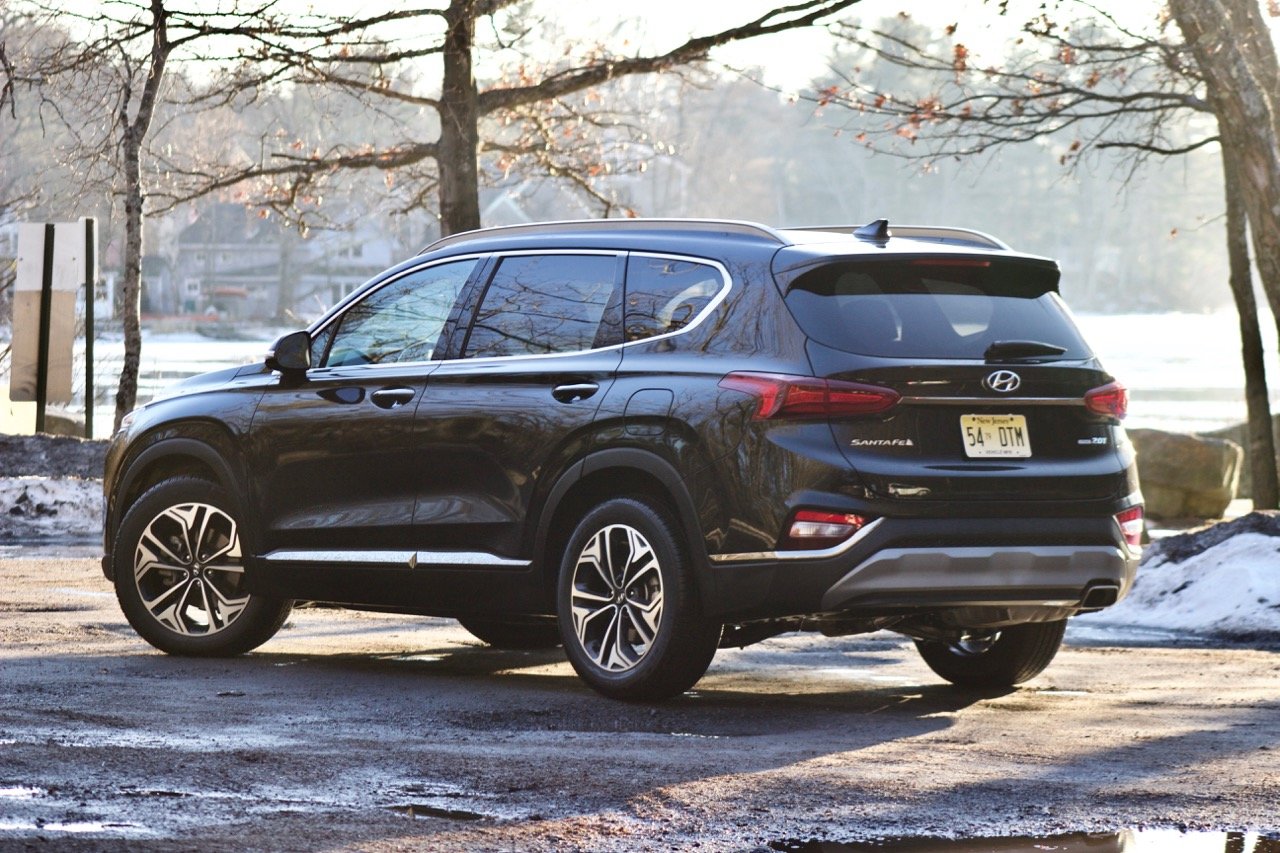
Hyundai styling has long been on the conservative side. When its vehicles did have bolder styling, they yet managed to look derivative, but that's all changing. The 2019 Santa Fe is leading the charge of a new generation of Hyundai vehicles with daring, bold, futuristic exteriors.
That doesn't mean the new Santa Fe's design is perfect. From 2014 to 2018 Jeep Cherokees featured an upper LED strip, which played the role of daytime running lights, and the principal headlight assemblies were in mid-level clusters, made to look like oversize fog lights. The new Santa Fe sports an eerily similar configuration, though Hyundai seems to execute this design more effectively.
While the exterior is futuristic, the interior is modernistic and practical. Interiors tin exist fun and filled with flair, but their main purpose is functionality. A car like the Kia Soul, for instance, can comprise funky interiors, but above all else, it has to be easy to utilize. Hyundai puts function first, with deep compartments in the doors and center console.
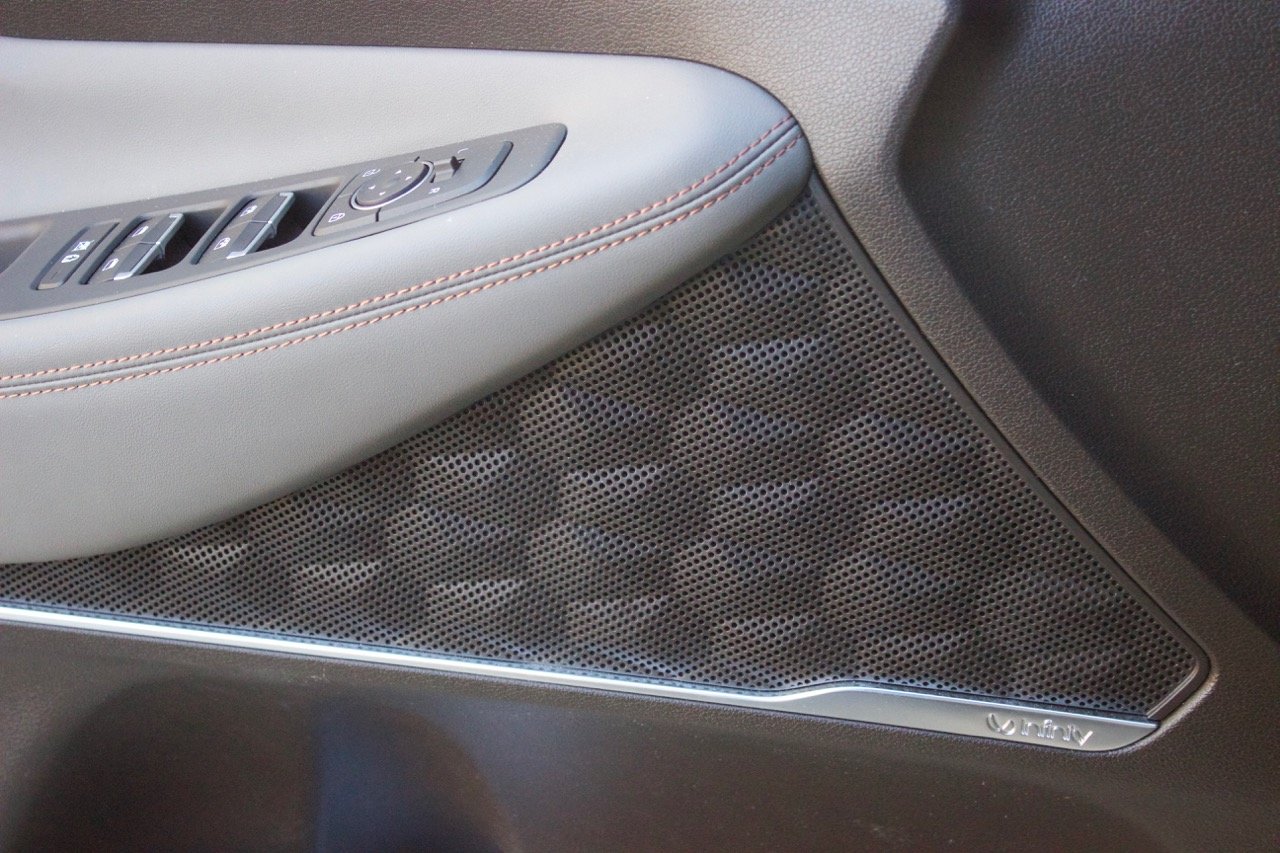
But that is non to say the cabin is devoid of style. It has a crisp, mod feel, but in a fashion that is different from nearly every other SUV interior on the market today. Our examination model has a surprisingly organic ambiance. It's bathed in earthy tones, a unique design on the speakers, and a neat composite inlay material that extends from the door into the dash. What sets this all off and makes it all work is the textured headliner. It is woven and almost feels like sweatshirt cloth.
Trims for the Santa Fe are SE, SEL, SEL Plus, Limited, and Ultimate. The base SE trim comes standard with standard 17-inch alloy wheels, loftier-beam assist, power heated side mirrors, and LED daytime running lights. Inside, the seats are transmission control all around, just y'all as well become remote keyless entry.
Moving up, the SEL trim adds fog lights, an 8-way power driver's seat, heated front seats, and push-button start. The SEL Plus bridges the gap betwixt the value-oriented lower trims and the upscale terminate of the lineup. It adds 18-inch alloy wheels, parking sensors, rear-occupant alarm, dual automated climate control, and a 630-watt Infinity sound arrangement with 12 speakers.
Moving up to the Express adds total LED head- and taillights and incorporates turn signals into the side mirrors. The Express also brings us into the premium realm, with satin chrome door handles, a massive panoramic sunroof, and leather seating.
But our range-topping Ultimate trim test vehicle truly lives up to the name. Information technology's loaded up with rain-sensing wipers, retention settings for the front seats, heated front end and rear seats, and ventilated front seats.
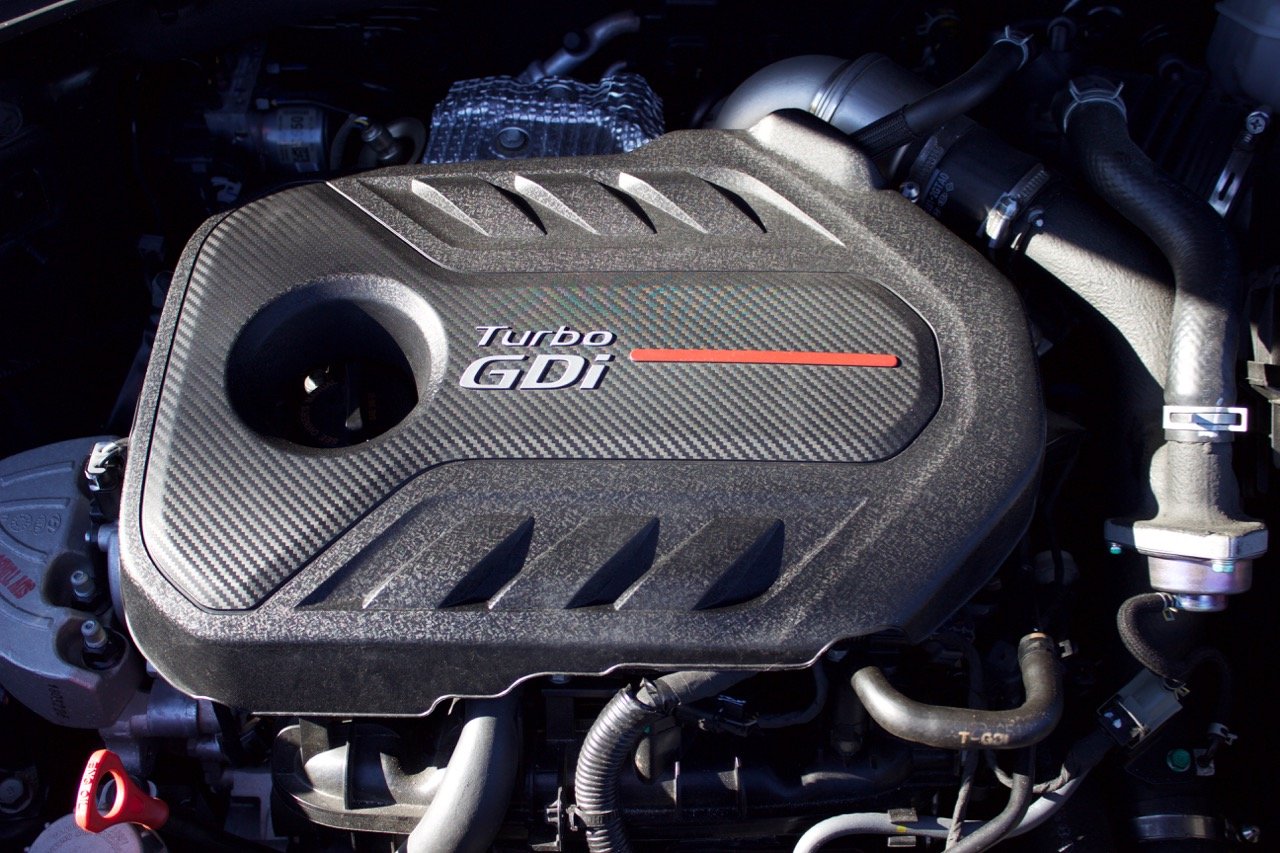
There are two engines bachelor for the 2019 Santa Iron. All trims come standard with the base ii.4-liter iv-cylinder engine, making 185 horsepower and 178 pound-feet of torque.
The Express and Ultimate are available with a turbocharged 2-liter 4-cylinder engine that makes 235 horsepower and 260 pound-anxiety of torque. No affair the engine, power gets sent through an 8-speed automatic transmission to the front wheels or bachelor all-wheel drive (AWD).
The base engine is noted every bit being sluggish, which is unfortunate because the 2.0T is neat. It's too bad this engine is not available in a lower trim, like the SEL Plus, every bit it would be a great alloy of operation and value. The 2.0T provides strong acceleration, both off the line and at highway speeds.
Despite feeling very upright, the Santa Atomic number 26 actually sits pretty depression to the footing, with just 7.2 inches of ground clearance. Fifty-fifty the Subaru Outback wagon has 8.7 inches, and while that means you won't be able to take the Santa Atomic number 26 too far off-road, it also means the Hyundai crossover feels pretty level in corners. There is not as much trunk roll as you might expect for a vehicle this size. And the AWD Santa Fe does have a locking differential, which could help when driving through a muddy field or on the beach.
Dorsum on the route, the Santa Fe shows real sophistication in its driving dynamics. The steering feels ideally weighted, and the turning response is actually pretty tight. Information technology's not overly heavy but information technology provides a level of feedback you might not wait from the family-hauling crossover segment. For a family unit vehicle, the Santa Fe actually feels pretty well continued to the road.
The Santa Fe has a bulldoze style selector with Sport, Condolement, and Smart settings. These presets can alter the throttle response, shift-mapping and, for AWD variants, the power dispersal to all four wheels.
The well-nigh fuel-efficient Santa Fe is a front-wheel-bulldoze (FWD) version with the 2.4-liter engine. That should return 22 mpg city, 29 urban center, 25 combined. Our AWD turbo model should return nineteen mpg metropolis, 24 highway, 21 combined. And, in our week of combined city and highway driving, we actually recorded an average fuel economic system of 22 miles per gallon.
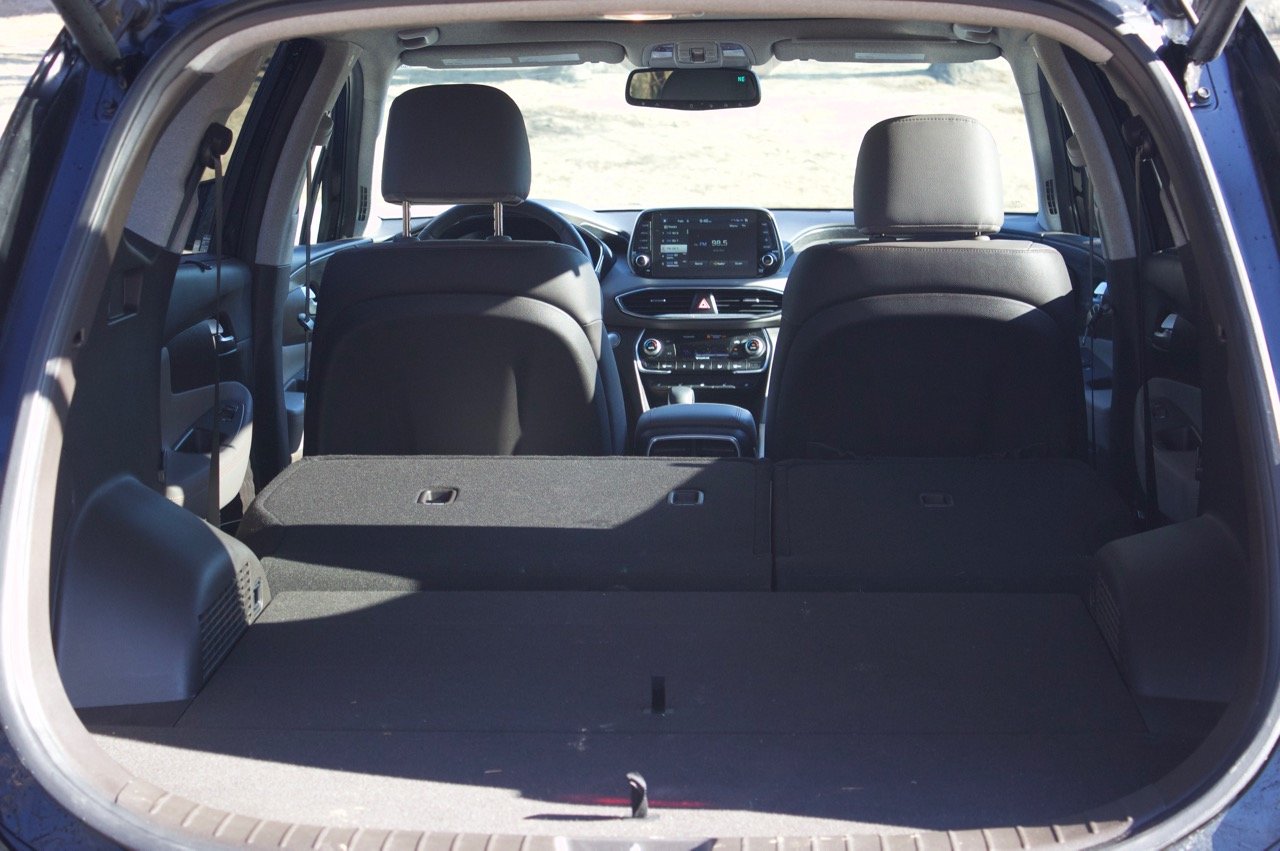
With the rear seats folded, the Santa Fe offers 71 cubic feet of cargo infinite, which isn't much for a supposedly "midsize" crossover. It's 4 cubic feet less than the compact Honda CR-5, which has 75. The 60/40 divide-fold rear bench is like shooting fish in a barrel to drop with levers on the side of the seats, or via rear buttons that are easily reachable while standing at the opened rear hatch. With the rear seats up, the Santa Iron has 35.nine cubic anxiety of cargo space. The CR-Five has 39.ii.
The Santa Iron is available with a easily-free power liftgate that doesn't crave balancing on one leg like some other systems. Just walk up to the dorsum of the Santa Atomic number 26 with the key fob in your hand or pocket. The machine will beep or wink the lights to signal it knows the fob and you are back in that location. Then after a few seconds, it'll automatically deploy.
Considering its paltry cargo figures, it'southward a good thing the Santa Fe is rife with clever storage solutions, including multiple compartments in the rear, bins in the front and rear doors, and deep center console bins.
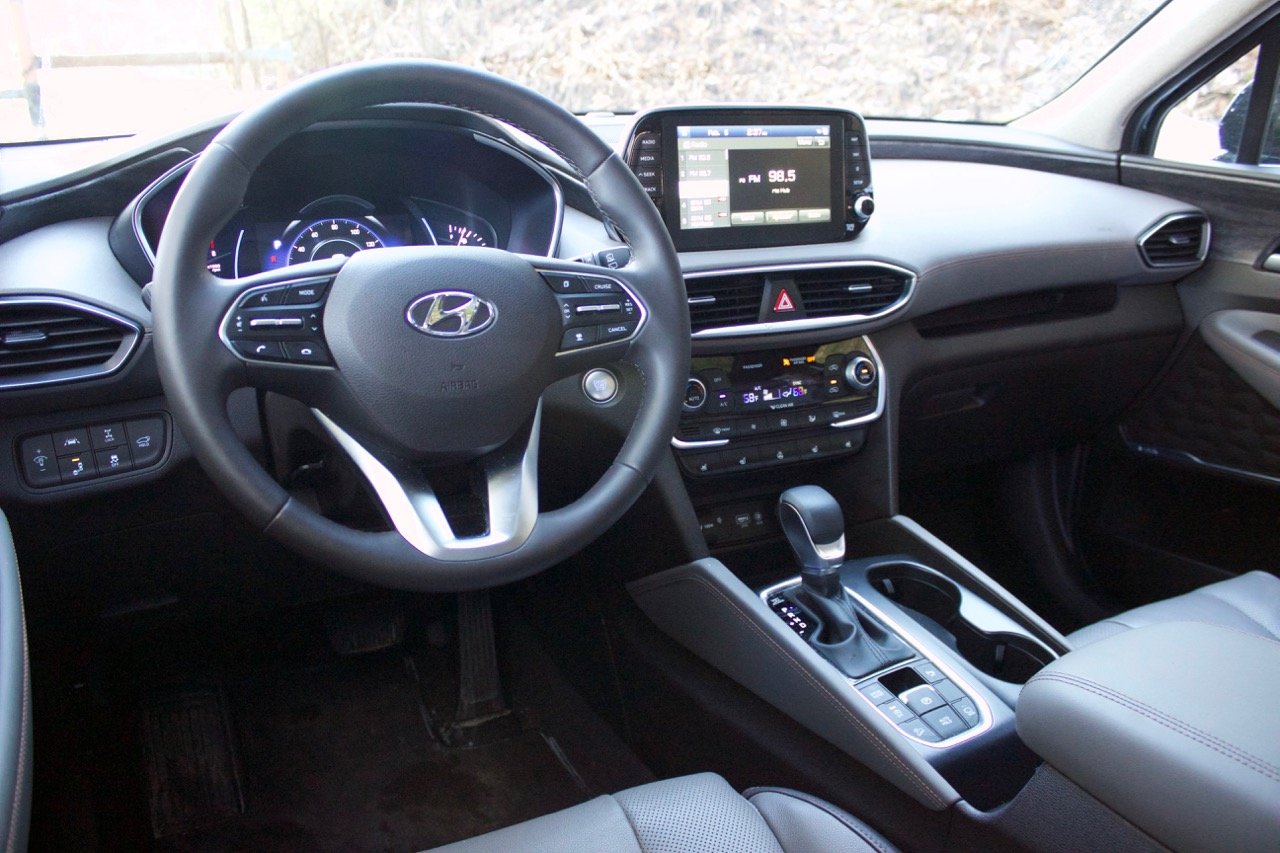
There is a recent tendency among automotive interiors in which infotainment systems are packaged in "floating" screens, placed atop the dash. I've often criticized these as lazy designs, but afterwards repeatedly using them in multiple vehicles, I don't mind them anymore. In the Santa Iron, specifically, you've got hard buttons and dials on either side of the screen to autumn back on, meaning there is a minimal learning curve.
The touchscreen system itself has a logical layout and is like shooting fish in a barrel to employ. Information technology has vivid graphics, crisp fonts. The Santa Atomic number 26's base SE trim comes with Bluetooth connectivity, a USB port, and a 7-inch touchscreen infotainment system with Apple CarPlay and Android Car. SEL and to a higher place get satellite radio, Hd Radio, and Hyundai's BlueLink infotainment arrangement, which now features Alexa integration. The Ultimate caps things off with a head-up brandish and a wireless charging pad, and information technology upgrades the infotainment to a larger 8-inch touchscreen. Hyundai makes a nice choice of putting the heated seat switches on the door, making them easier to reach. Our Ultimate test vehicle too featured rear USB ports and a wall-style power outlet.
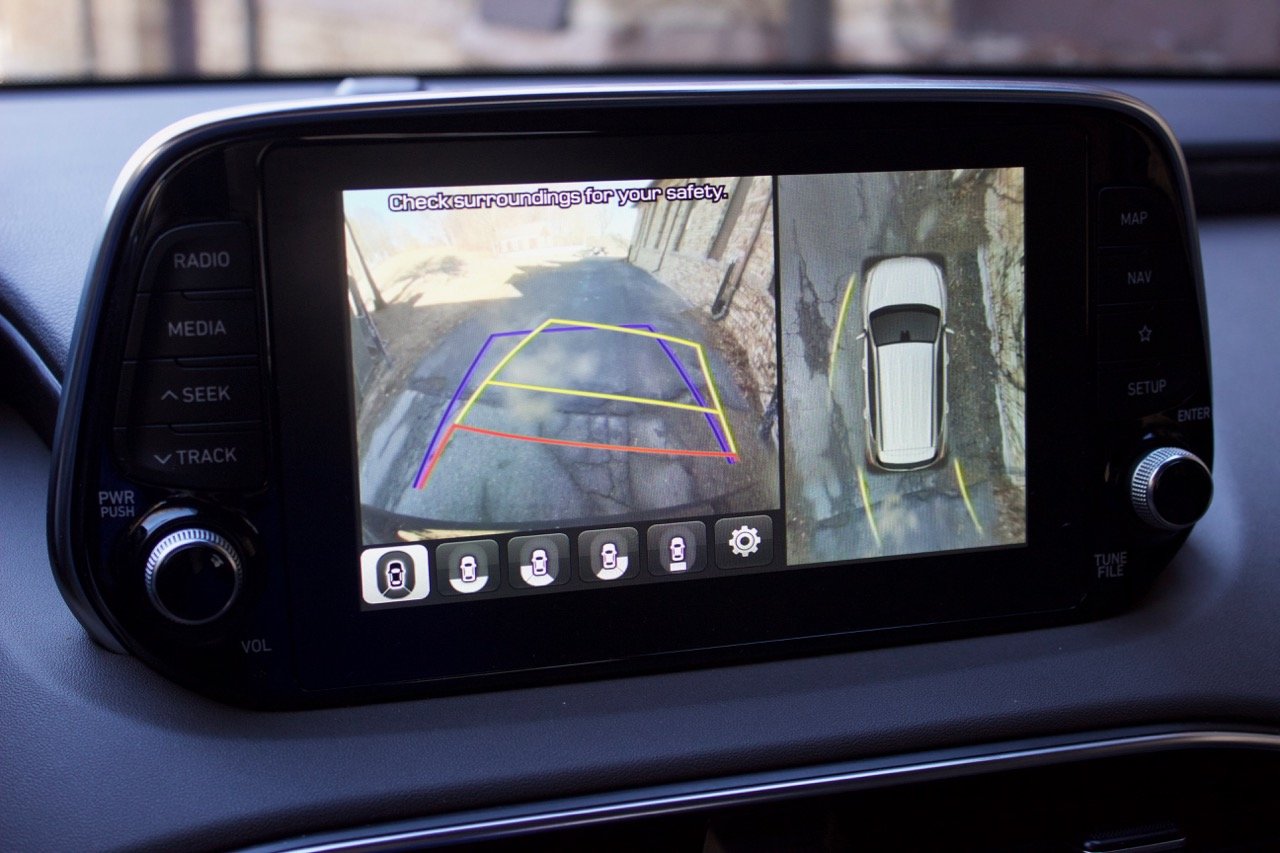
The Santa Fe comes standard with a full array of front- and side-affect airbags, a reversing camera, and a tire pressure monitoring organization. It's also among the latest crop of vehicles to come standard with a full suite of driver-assistance features. Hyundai calls information technology Smart Sense, and it includes frontward-collision avoidance, blind-spot monitoring, lane-departure warning, and adaptive cruise control that tin stop and go with traffic.
It besides has rear cross-path detection and, more than the typical visual and aural alert, it provides visual cues in the instrument panel to tell you what side of the vehicle the issue is on. This is simple, effective, and helpful.
A new standard feature on the Santa Atomic number 26 is the Condom Exit Aid Organisation. In that location's a button on the driver's side door that looks like the child-proof lock button, but when activated, the rear kid-proof locks get tied to the blind-spot monitoring. If a car is coming up on your flank, the rear doors won't open up. This is rather bright.
The 2019 Hyundai Santa Iron has a base MSRP of $25,500, and the SEL starts at $27,600, while the Limited starts at $32,600. A Express Turbo starts at $34,200, and the range-topping Ultimate Turbo AWD costs $38,800. This is very much in line with compact SUV pricing, and if information technology'south value you seek, CarGurus recommends the base of operations SE trim. It offers tons of content equally standard equipment, though if you want more than creature comforts, the SEL Plus is a bang-up blend of value and features.
"In-between" SUVs are becoming more than pop. A segment that really only included the Ford Edge and Nissan Murano now includes the upcoming Honda Passport, and you can probably add the Santa Fe to that as-even so-undefined form of vehicle. There probably needs to be a realignment of vehicle class. Whenever that happens, the Santa Fe will be there.
Hyundai's played things pretty safe with its showtime cars for the American market, and if you've haven't been paying shut attention, you might think the company notwithstanding takes that prophylactic route. But the Korean automaker has serious ambitions. This is the brand that created the Veloster sports car and the Genesis brand. The Hyundai Santa Fe should be taken seriously, as it has the goods to be considered one of the peak SUVs on the market. The combination of bold styling, equanimous driving, and solid value make the Hyundai Santa Fe an SUV with which to be reckoned.
Source: https://www.cargurus.com/Cars/2019-Hyundai-Santa-Fe-Overview-c27552
0 Response to "2019 Hyundai Santa Fe Sel Plus 24 Review"
Post a Comment