Dust Thou Art to Dust Returnest Was Not Spoken of the Soul
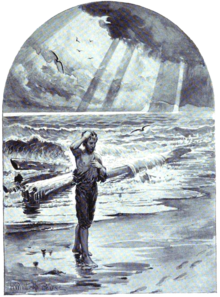
"Footprints on the sands of time", c. 1891 analogy
A Psalm of Life
Tell me not, in mournful numbers,
Life is but an empty dream!—
For the soul is dead that slumbers,
And things are non what they seem.Life is real! Life is hostage!
And the grave is non its goal;
Dust thou art, to dust returnest,
Was non spoken of the soul.Non enjoyment, and non sorrow,
Is our destined terminate or way;
But to act, that each to-morrow
Detect united states of america farther than to-day.Art is long, and Time is fleeting,
And our hearts, though stout and brave,
Still, similar deadened drums, are beating
Funeral marches to the grave.In the world's broad field of battle,
In the campfire of Life,
Exist non like impaired, driven cattle!
Be a hero in the strife!Trust no Future, howe'er pleasant!
Let the dead Past bury its dead!
Act,—act in the living Nowadays!
Heart inside, and God o'erhead!Lives of peachy men all remind united states
We can make our lives sublime,
And, departing, go out backside us
Footprints on the sands of time;Footprints, that mayhap another,
Sailing o'er life's solemn main,
A forlorn and shipwrecked blood brother,
Seeing, shall take heart once again.Allow united states, then, exist up and doing,
With a centre for any fate;
Still achieving, still pursuing,
Learn to labor and to wait.
"A Psalm of Life" is a poem written past American author Henry Wadsworth Longfellow, often subtitled "What the Centre of the Fellow Said to the Psalmist".[1] Longfellow wrote the poem not long afterwards the death of his first wife and while thinking about how to make the best of life. Information technology was first published anonymously in 1838 before being included in a collection of Longfellow'due south poems the next year. Its inspirational bulletin has made information technology ane of Longfellow's most famous poems.
Limerick and publication history [edit]
Longfellow wrote the poem before long later on completing lectures on German language author Johann Wolfgang von Goethe and was heavily inspired by him. He was also inspired to write information technology by a heartfelt chat he had with friend and fellow professor at Harvard University Cornelius Conway Felton; the 2 had spent an evening "talking of matters, which lie virtually i's soul:–and how to bear one's self doughtily in Life's battle: and make the best of things".[ii] The next mean solar day, he wrote "A Psalm of Life". Longfellow was further inspired past the decease of his first wife, Mary Storer Potter,[3] and attempted to convince himself to accept "a center for any fate".[one]
The verse form was first published in the October 1838 issue of The Knickerbocker,[1] though it was attributed only to "50." Longfellow was promised five dollars for its publication, though he never received payment.[4] This original publication also included a slightly altered quote from Richard Crashaw every bit an epigram: "Life that shall transport / A challenge to its finish, / And when it comes, say, 'Welcome, friend.'"[5] "A Psalm of Life" and other early poems past Longfellow, including "The Village Blacksmith" and "The Wreck of the Hesperus", were collected and published as Voices of the Night in 1839.[vi] This volume sold for 75 cents[7] and, past 1842, had gone into half dozen editions.[eight]
In the summer of 1838, Longfellow wrote "The Light of Stars", a poem which he called "A Second Psalm of Life".[ix] His 1839 poem inspired by the death of his married woman, "Footsteps of Angels", was similarly referred to as "Voices of the Night: A Third Psalm of Life".[x] Another poem published in Voices of the Night titled "The Reaper and the Flowers" was originally subtitled "A Psalm of Death".[11]
Analysis [edit]
The poem, written in an ABAB pattern, is meant to inspire its readers to live actively, and neither to lament the past nor to take the time to come for granted.[1] The didactic message is underscored past a vigorous trochaic meter and frequent assertion.[8] Answering a reader'south question about the poem in 1879, Longfellow himself summarized that the verse form was "a transcript of my thoughts and feelings at the time I wrote, and of the confidence therein expressed, that Life is something more than an idle dream."[12] Richard Henry Stoddard referred to the theme of the verse form as a "lesson of endurance".[13]
Longfellow wrote "A Psalm of Life" at the beginning of a period in which he showed an interest in the Judaic, specially strong in the 1840s and 1850s. More specifically, Longfellow looked at the American versions or American responses to Jewish stories. Most notable in this strain is the poet's "The Jewish Cemetery at Newport", inspired by the Touro Cemetery in Newport, Rhode Isle.[xiv]
Further, the influence of Goethe was noticeable. In 1854, an English associate suggested "A Psalm of Life" was merely a translation. Longfellow denied this, but admitted he may have had some inspiration from him as he was writing "at the commencement of my life poetical, when a thousand songs were ringing in my ears; and doubtless many echoes and suggestions will exist found in them. Let the fact go for what information technology is worth".[15]
Modern scholar Angela Sorby notes that, despite it being one of his earlier poems, "A Psalm of Life" embodies Longfellow'due south strongest messaging for young people to seek greatness. She further notes the message is even stronger than other examples of his works with like themes like "Paul Revere's Ride" and The Vocal of Hiawatha.[xvi]
Response [edit]
"A Psalm of Life" became a popular and oft-quoted poem, such that Longfellow biographer Charles Calhoun noted information technology had risen beyond being a verse form and into a cultural artifact. Amid its many quoted lines are "footprints on the sands of time".[iii] In 1850, Longfellow recorded in his journal of his delight upon hearing it quoted by a minister in a sermon, though he was disappointed when no member of the congregation could identify the source.[1] Not long after Longfellow's death, biographer Eric S. Robertson noted, "The 'Psalm of Life,' neat verse form or not, went directly to the hearts of the people, and found an echoing shout in their midst. From the American pulpits, right and left, preachers talked to the people about it, and information technology came to be sung as a hymn in churches."[17] The poem was widely translated into a variety of languages, including Sanskrit.[1] Joseph Massel translated the verse form, besides every bit others from Longfellow'due south later drove Tales of a Wayside Inn, into Hebrew.[xviii] By 1879, the poem was included in the sixth edition of McGuffey Readers.[xix]
Calhoun likewise notes that "A Psalm of Life" has become one of the most frequently memorized and well-nigh ridiculed of English poems, with an ending reflecting "Victorian cheeriness at its worst".[3] Modern critics have dismissed its "carbohydrate-coated pill" promoting a false sense of security.[13] Still, Longfellow scholar Robert L. Gale referred to "A Psalm of Life" every bit "the nearly popular verse form always written in English".[one] One story has it that a homo once approached Longfellow and told him that a worn, hand-written copy of "A Psalm of Life" saved him from suicide.[20] Edwin Arlington Robinson, an admirer of Longfellow'southward, likely was referring to this poem in his "Ballade by the Fire" with his line, "Be upwards, my soul".[21] Despite Longfellow's dwindling reputation among modernistic readers and critics, "A Psalm of Life" remains one of the few of his poems notwithstanding anthologized.[22]
Notes [edit]
- ^ a b c d due east f g Gale, 202
- ^ Thompson, 267
- ^ a b c Calhoun, 137
- ^ Cody, Sherwin. 4 American Poets: William Cullen Bryant, Henry Wadsworth Longfellow, John Greenleaf Whittier, Oliver Wendell Holmes; a Book for Young Americans. New York: Werner School Volume Company, 1899: 106–107. Accessed August 12, 2008
- ^ Pelaez, 55, 67
- ^ Calhoun, 137–139
- ^ Irmscher, 54
- ^ a b Pelaez, 54
- ^ Thompson, 270
- ^ Gale, 85
- ^ Gruesz, 49
- ^ Hilen, Andrew (editor). The Letters of Henry Wadsworth Longfellow. Cambridge, MA: Harvard University Press, 1982: vol. VI, 449. ISBN 0-674-52728-3
- ^ a b Pelaez, 55
- ^ Einboden, xx–21
- ^ Gruesz, 59
- ^ Sorby, 25
- ^ Robertson, Eric Southward. Life of Henry Wadsworth Longfellow. London: Walter Scott, 1887: 78–79.
- ^ Einboden, 27
- ^ Sorby, 26
- ^ Gruesz, lx
- ^ Gale, Robert L. An Edwin Arlington Robinson Encyclopedia. McFarland & Company, 2006: 24. ISBN 9780786422371
- ^ Irmscher, 19
References [edit]
- Calhoun, Charles C. Longfellow: A Rediscovered Life. Boston: Beacon Press, 2004. ISBN 0-8070-7026-2.
- Einboden, Jeffrey. Nineteenth-Century United states Literature in Centre Eastern Languages. Edinburgh University Press, 2013. ISBN 978-0-7486-4564-0
- Gale, Robert Fifty. A Henry Wadsworth Longfellow Companion. Westport, CT: Greenwood Publishing Group, 2003. ISBN 978-0-313-32350-8
- Gruesz, Kirsten Silva. "Feeling for the Fireside: Longfellow, Lynch, and the Topography of Poetic Ability" in Sentimental Men: Masculinity and the Politics of Affect in American Civilization (Mary Chapman and Glenn Hendler, editors). Berkeley, CA: Academy of California Press, 1999. ISBN 0-520-21621-0
- Irmscher, Christoph. Longfellow Redux. Chicago: University of Illinois Printing, 2006. ISBN 978-0-252-07586-five
- Pelaez, Monica. "'A Dearest of Heaven and Virtue': Why Longfellow Sentimentalizes Death" in Reconsidering Longfellow (Christoph Irmscher and Robert Arbour, editors). Madison, WI: Fairleigh Dickinson Academy Press, 2014. ISBN 978-1-61147-673-6
- Sorby, Angela. Schoolroom Poets: Childhood, Performance, and the Identify of American Poetry, 1865–1917. Lebanon, NH: University of New Hampshire Printing, 2005: 25. ISBN 1-58465-458-9
- Thompson, Lawrance. Young Longfellow (1807–1843). New York: The Macmillan Company, 1938.
External links [edit]
- Original publication in The Knickerbocker
- "A Psalm of Life" read by Rev. Michael Eastward. Haynes, at the "Favorite Poem Projection" (Boston Academy and the Library of Congress
- Annotated version of the poem, genius.com
- "A Psalm of Life: The Verse form" by Don Meyer, PhD, Huffpost.com, two/xiii/2013
Source: https://en.wikipedia.org/wiki/A_Psalm_of_Life
0 Response to "Dust Thou Art to Dust Returnest Was Not Spoken of the Soul"
Post a Comment